How NNPC Illegally Diverted $20 Billion From The Federation Account -CBN Governor Sanusi
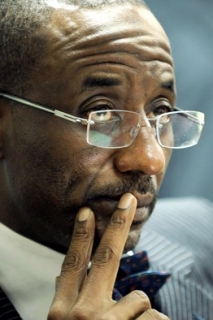
CBN Governor, Sanusi Lamido Sanusi
I am pleased to stand before you and present a summary of my latest
submission on this subject. The submission itself is about 20 pages long
with 30 Appendices, providing documentary backing for all material
statements. The background to this session remains my letter to the
President in which I indicated that there was a difference between the
value of crude lifted by NNPC between January 2012 and July 2013 and the
amount of foreign exchange repatriated into the Federation Account.
This difference was placed at almost $50 billion and I respectfully
advised the President to order an investigation into a number of areas I
suspected were responsible for leakages in oil revenue.
My letter was, sadly, leaked and published in a highly
politically-charged atmosphere. The Central Bank was practically accused
of involvement in politics and in December it was clear to me that no
tempered and positive discussion would take place. In order to calm
nerves and avert major crisis I agreed to a joint press conference with
Finance Ministry, the Petroleum Ministry and also to present a common
front at the National Assembly.
Since December, however, there has been an orchestrated campaign
aimed at undermining our credibility and misleading Nigerians into
believing that all monies due to the Federation Account have been either
remitted or accounted for. I am, therefore, compelled to present to
this committee detailed evidence that NNPC has in violation of the law
and constitution been diverting money from the Federation Account, and
involving itself in activities that warrant full investigation for more
serious violations of the law.
I have established, in my presentation, the following:
1. That NNPC, in paying what it calls kerosene subsidy, is confessing
to a number of serious infractions. First, I have shown, based on NBS
data, that kerosene is not a subsidised product, and, therefore, the
so-called subsidy is rent generated for the benefit of those in the
kerosene business. Second, I have produced evidence that President
Yar’Adua had issued a presidential directive eliminating this subsidy
payment as from July, 2009. Third, these huge losses inflicted on the
Federation Account have not been appropriated.
The burden of proof on NNPC is to show where they obtained
authorization to purchase kerosene at N150/litre from Federation Funds
and sell at about N40/litre, knowing fully well that this product sells
in the market at N170-N220/litre. At what point was the presidential
directive revered? NPA records would suggest that NNPC imports about 4-6
vessels of kerosene a month. Industry sources place the value of each
vessel at $30m and the amount of “subsidy” per vessel at $20m. This
means, at an average of 5 vessels a month, the Federation Account loses
$100m every month to this racket.
2. I have also shown, in my submission, that claims by NNPC of
spending the money on PMS subsidy are not credible. I have submitted
proof that as from April, 2012, NNPC has consistently rendered returns
to FAC indicating that it made no deduction for subsidy. This is after
rendering returns on amount deducted monthly for 20 consecutive months
to March, 2012. NNPC had previously explained that it had stopped
deductions from 2011 and that the N180b taken in Q1:2012 related to fuel
imports for Q4:2011. As from 2012, the directive was for NNPC to submit
its papers to PPPRA, the relevant government agency set up and given
the responsibility for verifying and paying subsidy claims. Having
officially reported that it was not making deduction for fuel in 2012
and 2013, it is surprising that the GMD and GED of NNPC would now claim
that $8.49b was used to pay for subsidy.
I am convinced that a major source of revenue leakage from the system
is NNPC’s unverified claims for subsidy and unilateral deduction from
the Federation Account. If we take the PPPRA template, subsidy/litre of
PMS is about 1,136litre/MT, the subsidy is around N1.5b. This means that
for every $1b claimed by NNPC as subsidy deduction, the corporation is
claiming to have imported at least 100 vessels of PMS. In addition to
the N180b reported in Q1:2011, NNPC had deducted N845 billion in 2011.
According to the Farouk Lawan report, NNPC deduction for PMS subsidy in
2011 alone amounted to N1.7 trillion, if we add claims on Excess crude
naira account. Any serious investigation into these matters will require
an audit of NNPC’s database which it is statutorily required to keep
based on subsidy guidelines. Only verification of the legitimacy of
these claims can form the basis for a true reconciliation.
3. Based on NNPC’s disclosure to the effect that it shipped $6b worth
of crude oil on behalf of NPDC, I have argued here that at least a part
of this amount is due to the Federation Account. This part relates to
oil produced from blocks operated under “Strategic Alliance Agreement”. I
have given you three legal opinions that unanimously argue that these
agreements merely serve to transfer revenue due to the Federation to
private hands. I have also shown how, based on these arguments, NNPC has
effectively given tax relief and concessions to its business partners.
Also customs duties and levies are treated as “development costs” and
recouped from “cost oil” and “cost gas”. These companies recover OPEX
and COPEX from production, take 20-70 per cent of the profit and pay no
tax, on JVs in which the Federation was previously entitled to 55 per
cent of the entire profit oil when Shell was the operator. I have given
details of these transactions and my concerns in the paper.
4. Although the above 3 areas exhaust the areas covered in NNPC’s
explanations, I have also taken time to submit my analysis of the
crude-for-refined-product swap contracts entered into by PPMC. This is
because a significant part of the domestic crude taken by NNPC is in
these transactions. I have indicated where i believe we are losing money
in these transactions.
Reconciliation :
Having thus explained my major opinions on NNPC‘s explanations, I will come to the reconciliation.
NNPC itself has submitted that it lifted $67b worth of Crude between
January 2012 and July 2013. Of this, we have been able to agree that the
following amounts have been remitted to the Federation Account:
1. $14 billion as equity crude
2. $15 billion as payment to FIRS by IOCs. They paid in crude which
was lifted by NNPC on behalf of FIRS. There was nothing in our records
linking the two transactions.
3. $2 billion Royalty payment to DPR by IOCs under similar arrangements as in (2) above.
4. $16 billion out of the 428b taken as Domestic Crude Paid in Naira, not dollar.
The following items are outstanding and need to be proven by NNPC:
1. $12 billion out of domestic crude sales yet to be remitted. NNPC
has already disclosed N180 billion as subsidy payment in Q1.2012. If
PPPRA confirms this number, we will adjust the balance accordingly. As
for the balance of $10.8 billion, NNPC has publicly disclosed that 80
per cent applied to petrol and kerosene subsidy. We have already
explained why this explanation is untenable and NNPC needs to provide
the relevant proofs.
2. $6 billion shipped on behalf of NNPC. We have explained why some
this belongs to the Federation and the need to investigate and audit the
SAAS to recover amounts unconstitutionally diverted.
3. $2 billion “third-party” financing” we have not been given any
documents explaining or proving this along with other claims around
pipeline repairs, maintenance, strategic reserves etc.
There was no appropriation for these expenses and NNPC also needs to substantiate them.
In summary, it is established that of the $67 billion crude shipped
by NNPC between January 2012 and July 2013, $47 billion was remitted to
the Federation Account. It is now up to NNPC, given all the issues
raised, to produce the proof that the $20billion unremitted either did
not belong to the Federation or was legally and constitutionally spent.
There is no dispute that $20 billion out of $67 billion has not been
paid into any account with the CBN.
Our recommendation remains that this matter requires thorough independent investigation, as simple explanation will not suffice.
I concluded my submission with recommendation for the future, to protect the economy from these unsustainable losses.
I would like to make the following recommendations going forward:
Recommendations :
NNPC should stop collecting 440,000bbl daily as “Domestic Crude”. The
amount of crude should be reduced to the refining capacity of its
refineries based on a signed refining contract that clearly states what
products are to be delivered for each barrel. Sale proceeds net of
recognised processing costs are to go to the Federation Account;
All Crude for Product Swaps should be terminated and crude should be exported and sold at market price.
Where NNPC needs to generate cash flow to fund PMS imports, it can
“borrow” crude, on the approval of the Finance Minister, for 90 – 120
days. This crude is to be valued at the ruling market price. NNPC may
sell the crude, import PMS and sell through its outlets. It should claim
subsidy from PPPRA like every other marketer and present all required
documents. Thereafter, NNPC should pay back the full value of crude
lifted to the Federation Account and retain the profit. Where NNPC
delays payment, the amount outstanding should attract interest at
commercial rates until payment.
All the SAAs entered into by NPDC should be investigated for
constitutionality. The production numbers, Opex and Capex, and profit
shares should be audited. The tax arrangements entered into with these
parties should be reviewed and all revenues due to the Federation
collected. If possible the SAAs should be terminated. Certainly, NNPC
should be prohibited from entering into any SAAs in the future.
NNPC to account for subsidies claimed in 2010-13 by producing documentary proof of legitimacy.
As for what action needs to be taken on what has happened in the
past, we express no opinion. The decision on what to do in this case
rests entirely with the Government. My task is limited to raising an
alarm over what I think is a development that is harmful to the economy,
and establishing that the alarm was neither spurious nor baseless. I
still insist that an investigation is needed to establish the extent of
the losses and the nature of offence committed.
I believe I have placed enough information before this committee to
make the point. The amount in 19 months may be $12 billion or $19
billion or $21 billion, we do not know at this point but if we extend
the period the amount will increase anyway, since this has been going on
for a long time. The first priority is to stop it. It is unsustainable,
and it will ultimately, if not stopped, bring the entire economy to its
knees.